 |
|
CINEMA...
CINEMA... CINEMA...
|
||
|
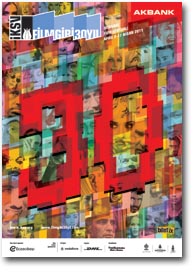
International Istanbul Film Festival Is 30 Years Old! THE FESTIVAL THAT ARRIVES WITH THE SPRING IS BETWEEN APRIL 2-17
INSIDE OF THE FESTIVAL
April 6th
* DERVİŞ ZAİM DESCRIBED HIS CINEMA Derviş Zaim, whose most recent film Shadows and Faces will be screened at the Festival, held a chat at Akbank Sanat about his cinema and shared his experiences with younger people who wanted to get into filmmaking. Explaining that he made his first film Somersault in a Coffin "guerilla style," Zaim said, "I do not stand by the established cinema sector, I am an extrinsic man. I need to create my own circumstances. Süha Arın gave the camera and the lights. Actors and the crew behind the camera did not get paid. We shot the film with 60 boxes of film in 17 days." Zaim said the monopolization in the distribution of films will spread to the production process and that in a couple of years the Turkish cinema sector will hit a wall, resembling the Hollywood of the 1950s. When asked whether he is considering making an adaptation of a literary work, Zaim said the adaptation of well-written and well-known books was an unnecessary burden. He added, "If I find a literary work that is written badly enough, I will make it into a movie." Asked why he was making cinema, Zaim replied, "Because this is the job I can do best." * THE STORY OF SONIA IN LIMBO Director Maria Sødahl and the film's leading actress Line Verndal attended the first screening of Limbo at the Festival. The film tells the tragic story of Sonia, who, with her two children, leaves Norway for Port-au-Spain in Trinidad to meet her oil engineer husband Jo. However, she soon starts feeling like an outsider among other expatriate Scandinavian wives. A Q&A session was held following the screening at the Atlas Movie Theatre. Sødahl said that the story took place in the 1970s because she "wanted to be away from the modern noise of today and closer to her characters." April 7th * A "COMING OF AGE" STORY FOR ADULTS Limbo director Maria Sødahl and lead actress Line Verndal met their audience in Istanbul for the second time. Sødahl said the final act of Sonia in the film meant that she chose freedom. She said that the relationship between men and women are universal and that Limbo was a "coming of age story" for adults. *IN HOMELAND Syllas Tzoumerkas, the director of Homeland, which recounts three political periods in Greece since the 1950s through the story of three generations of a family, answered questions from the audience following the film's screening in Beyoğlu Movie Theatre. He said, "The most important question in the film is what happens when you suppress violence and what happens when you cannot hold it anymore and it erupts." Tzoumerkas said the generation that lived through the junta period treated their children badly and their grandchildren well and that this laid at the root of the clashes in the film. * 30 YEARS IN FILM WITH DORSAY During the chat at Akbank Sanat, film critic Atilla Dorsay related his experiences since the start of the Festival, celebrating its 30th anniversary. He said that the first year of the Festival was named "Film Days" and the event comprised of six films. The following year, the number of films had increased to 20, and it was separated from the Istanbul Festival, was moved to the month of April, and became an independent event on its own. Dorsay also related how a three-person supervising state committee had censured the films, how Şakir Eczacıbaşı struggled against them, how they had to cancel the screenings, and how they had difficulties in explaining the situation to the films' directors who had come to Istanbul. He said that the presence of Elia Kazan in the demonstration they held against censure effected the day's government and that the censure was thereby lifted. * COUNTDOWN WITH LUCY WALKER The day's final Q&A was held with renowned documentary filmmaker Lucy Walker, who directed Countdown to Zero and Wasteland. Collaborating with Lawrence Bender, the producer of Inglorious Basterds and An Inconvenient Truth, Walker draws a scary panorama of the threat created by nuclear weapons by hosting experts and world leaders in her documentary. She said they had a 20-days fast and difficult preparation period. Walker objected the view that the film was advocating the American stance and said, "When I say we should abolish nuclear weapons, I am talking about a universal abolishment."
* THE UNBEARABLE
HEAVINESS OF MAKING FILMS IN IRAN Iranian-born director Rafi
Pitts answered questions from the audience following the screening
of his latest film Hunter in Atlas Movie Theater. Hunter questions
the Iranian Revolution 30 years after its start through Ali, who
finds familial bliss after being released from jail but whose happiness
is quickly destroyed. Pitts said his film could not be exhibited
in Iran unfortunately. He added, "Because I make films that
contrast with the government. Making this film was difficult enough.
Moreover, it takes six months to receive permission for the script
only. You need to go to the ministry for six months." Pitts
received his permission before the elections and those that gave
him the permission were dismissed from their jobs after the elections.
"And they thought some things could change in Iran." It
was due to censure that Pitts ended up in the leading role: "Besides
the script, permits needed to be obtained for everyone from actors
to cameraman. If you were to change the name of one person, you
had to wait for another six months. When, on the first day of filming,
the actor thought he could not make this film, the film ceased to
have a leading actor. I ended up having to play the part."
Pitts said he wanted to depict a country on the verge of eruption:
"How could I know that soon there would be fights and that
streets would be in turmoil? This is why the film became a powerful
clash with real life." Asked how many revolutions would be
needed for his film to be shown in Iran, Pitts said, "I hope
I will not be too old by then," adding, "The behavior
towards Cafer Panahi is both ridiculous and sad. As filmmakers,
we only think about the truth. We occupy ourselves only about humanity.
We hold a mirror to the society. Unfortunately there is nothing
we can do about those that look into that mirror and find themselves
ugly." * TURQUAZE WAS IN TURKEY FOR THE FIRST TIME IN THE FESTIVAL Ghent-born Turkish director Kadir Balcı's was in Istanbul for the screening of his feature debut. The screening, which was also attended by actress Tilbe Saran, was received with interest. Balcı's film, which tells the story of a Turkish family that comes to Ghent, Belgium, and socializing with the city's locals, starts a life of its own, has autobiographical elements. The director said he was very excited about this first screening of his film in Turkey. He said the "first generation Turks" were those that were born in Turkey and immigrated to Germany, and that they did not have a sense of belonging, whereas the "second generation" was born there and could adopt much easier to Germany. Tilbe Saran said the script she had read was different from the film that resulted from it but that the film was much better.
April 9th * LA COMMUNE (PARIS, 1871) STARTS! One of the Festival's most anticipated films, La Commune (Paris, 1871) lasts 345 minutes and reenacts history. The film will be shown in Pera in three installments at 11.00, 13.30, and 16.00. The screening will be attended by the son of the film's director Peter Watkins, its editor and casting director Patrick Watkins. * FROM THE KIRGHIZ CINEMA Kirghiz director Aktan Arym Kubat draws a funny and touching portrait of small-town politics in a rapidly globalizing world in his film The Light Thief. The film can be seen at 13.30 in Fitaş 4. There will be a talk with Kubat following the screening of the film. * ESPECIALLY FOR CHILDREN A special screening with simultaneous dubbing of The Sandman and the Lost Sand of Dreams, which is shown under the Kids' Menu, will take place at 13.30 in Nişantaşı City's. The screening will be attended by Sinem Sakaoğlu, one of the film's directors. * "THE MOST GRIPPING GERMAN FILM OF THE YEAR" "The most gripping German film of the year" according to Programmkino, Picco sheds light on the everyday life of youth prison inmates in Germany. Philip Koch will attend the screening of the film at 16.00 in Atlas. * AN AUTOBIOGRAPHICAL DEBUT Ghent-born Turkish director Kadir Balcı's feature debut film Turquaze can be seen at 19.00 in Atlas with the participation of the director. The film, which tells the story of a Turkish family that comes to Ghent, Belgium, and socializing with the city's locals, starts a life of its own, has autobiographical elements. * ITALIAN-STYLE KEN LOACH Our Life, which had brought the "Best Actor" Award at Cannes for Elio Germano, can be seen at 19.00 in Fitaş 4. Described by Screen magazine as an "Italian-style Ken Loach film," the film tells the story of a working-class family. Director Daniele Luchetti will attend the film's screening. * LUCAS WARS Glorified by some, severely criticized by others, director George Lucas is without a doubt one of the most debated directors of the movie history. The People Vs. George Lucas stands as the unequaled documentary that studies the conflicting relationship spread over 30 years between Lucas and his fans. The Star Wars fan club members are expected to make an appearance at the screening, which will take place at 21.30 in Fitaş 1. It will also be attended by director Alexandre o. Philippe. * A TESTIMONY NOT TO BE MISSED Consisting of interviews and testimonials of the Holocaust, the masterpiece Shoah will be screened in its 450-minute-long original version. Director Claude Lanzmann will introduce his film in the screening of the film's first installment at 21.30 in Beyoğlu Movie Theater. * LITERATURE TAKES IT TO THE ROAD The documentary of the cultural project "European Literature goes to Turkey - Turkish Literature goes to Europe," which was carried in eight European countries and 24 cities throughout Turkey, On the Road will be screened at 19.00 in Pera. The writers that partook in the project will also be attending the screening. A talk will be held at 20.00 following the screening, with the participation of writer Mario Levi, translator and writer Murat Uyurkulak, writer Ayşe Kulin, Claudia Dollinger, one of those responsible for the traveling library in the film, film's producer Sabine Küper Büsch, and director Thomas Büsch. The talk will be moderated by Memet Ali Alabora.
* COMPETITIONS KICK OFF The screening of films that participate in the Festival's National and International competitions will start. The exciting race for Golden Tulips will begin with the arrival of jury members in Istanbul. * FROM FICTION TO FILM The film adaptation of Orhan Kemal's 72nd Ward, which takes as its subject the lives of prison inmates in 1940s, full of misery and pain, is part of the National Competition line-up. It will be screened at 13.30 in Atlas. Following the screening, there will be a colloquy with director Murat Saraçoğlu. * TAKE A CLOSER LOOK AT ISRAEL A mirror held to the Israeli society and politics, and, at the same time, a semi-documentary about television broadcasting and cinema, Revolution 101 can be seen at 13.30 in Fitaş 1. Director Doron Tsabari will attend the screening. * FOR MUSICAL LOVERS Directed by actor/director John Turturro, Passion is part documentary, part musical that studies the relationship between classical and popular music through Neapolitan songs. Its screening will take place at 13.30 in Fitaş 4, with the participation of actor Peppe Servillo. * AN EXTRAORDINARY AUTOBIOGRAPHY Considered as one of the pioneers of New Queer Cinema, in his debut Massillon, American video artist William E. Jones recounts his own story without using any actors, but by combining his own voice with beautiful images. Exhibited in many contemporary art institutions, this extraordinary autobiography can be seen at 13.30 in Pera. Jones will answer questions after the screening. * UNTITLED TALK Massillon's director William E. Jones, La Commune (Paris, 1871)'s editor, casting director, and floor manager Patrick Watkins, and Istanbul Biennial Director Bige Örer will attend the talk Untitled (Film), which carries the same name as the section resulting from the collaboration between the Istanbul Biennial and Istanbul Film Festival. The talk will take place at 16.30 in IKSV Salon. * SHOAH THROUGH ITS DIRECTOR'S EYES Claude Lanzmann, who is attending the Festival for the screening of Shoah's 450-minute long original version, will share the film's production process, how it is received 25 years after its first screening, how Holocaust is viewed today, and his opinion on the concept of forgetting. The talk will take place at 14.00 in IKSV Salon. * MY JOY IS FAR FAR AWAY In his debut fiction feature, famed Ukrainian documentary filmmaker Sergei Loznitsa takes us on a journey that plays with the conventions of narrative cinema while drawing a grim portrait of life in contemporary Russia. My Joy will be screened in 16.00 at Fitaş 4 with the participation of the director. * WHEN FOOTBALL GETS INVOLVED IN THE CRIME WORLD The documentary that examines the intersection of sports, crime, and politics via two Colombians that are a world apart personality-wise, The Two Escobars can be seen at 16.00 in Fitaş 1. Michael Zimbalist, one of the film's directors, will attend the screening. * ALEVIS' HIDDEN LIVES Carrying the segregation that the Alevi society has suffered to the big screen, Hidden Lives can be seen at 16.00 in Beyoğlu. Director A. Haluk Ünal will attend the screening. * HIS LATEST FILM WITH ZAİM Just like Waiting for Heaven, in which he elaborates the art of miniature, and Dot, in which he explores calligraphy, Derviş Zaim also undertook the production of the trilogy's final film, Shadows and Faces, in which he deals with the art of shadow play. The film's screening will take place at 19.00 in Atlas and Zaim will answer questions from the audience after the screening. * INCEST AND A VIOLENT LOVE STORY Parallelly handling a broken family and Greece, Homeland is based on real events. It follows this family through three generations and three political periods; it tells the story of incest and a violent love story. Director Syllas Tzoumerkas will attend the screening at 19.00 in Fitaş 4. * IRANIAN REVOLUTION AFTER 30 YEARS Iranian-born director Rafi Pitts's latest film Hunter questions the Iranian Revolution 30 years after its start through Ali, who finds familial bliss after being released from jail. Pitts will attend the screening at 19.00 in Beyoğlu Movie Theater. * ONE NIGHT, ALL OF A SUDDEN… The Movie is an action-thriller that recounts how the fate of two housemates, who have settled for their routine lives and do not question their pasts, changes all of a sudden when one night an unexpected guest arrives. The film can be seen at 21.30 in Beyoğlu with the participation of Kerem Topuz.
|
||

 *
MIRANDA RICHARDSON WAS IN ISTANBUL Accomplished actress Miranda
Richardson was in Istanbul for the screening of Nigel Cole's latest
film Made in Dagenham and she met her fans and viewers at Akbank
Sanat after the screening of the film in which Richardson portrays
female cabinet minister Barbara Castle, who at the end of the 1960s
paved the way for the Equal Pay Act in the UK. Richardson said Castle
was a very passionate and strong woman, adding, "I never had
the chance to meet her but I would have loved to have a drink with
her." The actress said that she would like the directors she
works with to believe that actors are intelligent, too, and not
to act like they know everything. Richardson said Robert Altman
and David Cronenberg had a special place among all the directors
she had worked with. She said, "Altman provides a reliable,
relaxed atmosphere. I had satisfaction working with him. He seems
vague but he is not. I have received the biggest compliment of my
life from Cronenberg. We were shooting a very difficult scene in
The Spider and he came up to me and said 'Directing you is like
driving a Ferrari.'" Richardson criticized the Hollywood system
and the fact that actresses receive lower wages than their male
counterparts. She added, "Producers think that a woman's face
will not be enough to carry a film. This is why there is still inequality
when it comes to wages."
*
MIRANDA RICHARDSON WAS IN ISTANBUL Accomplished actress Miranda
Richardson was in Istanbul for the screening of Nigel Cole's latest
film Made in Dagenham and she met her fans and viewers at Akbank
Sanat after the screening of the film in which Richardson portrays
female cabinet minister Barbara Castle, who at the end of the 1960s
paved the way for the Equal Pay Act in the UK. Richardson said Castle
was a very passionate and strong woman, adding, "I never had
the chance to meet her but I would have loved to have a drink with
her." The actress said that she would like the directors she
works with to believe that actors are intelligent, too, and not
to act like they know everything. Richardson said Robert Altman
and David Cronenberg had a special place among all the directors
she had worked with. She said, "Altman provides a reliable,
relaxed atmosphere. I had satisfaction working with him. He seems
vague but he is not. I have received the biggest compliment of my
life from Cronenberg. We were shooting a very difficult scene in
The Spider and he came up to me and said 'Directing you is like
driving a Ferrari.'" Richardson criticized the Hollywood system
and the fact that actresses receive lower wages than their male
counterparts. She added, "Producers think that a woman's face
will not be enough to carry a film. This is why there is still inequality
when it comes to wages."